The fastest progress in jiu jitsu usually comes from training smarter, not just training harder.
Adult Brazilian Jiu Jitsu can feel intimidating at first, especially in Las Vegas where the training scene is busy, schedules move fast, and many adults walk in juggling work, family, and a body that is not interested in being thrown around five nights a week. We get it, because we coach adults through that exact reality every day.
The good news is that adult learners tend to improve quickly when the training approach matches real life. Most adult classes in the valley run in the evening, many also offer mornings and weekend open mats, and it is common to see both gi and no-gi options on the class schedule. That convenience is helpful, but what really matters is how you use your time on the mats.
Below are five training secrets we teach and reinforce in our Adult Brazilian Jiu Jitsu in Las Vegas program so you can learn faster, stay safer, and keep showing up long enough for the results to stick.
Secret 1: Consistency beats intensity, especially for busy adults
If you want one principle to guide your first six months, make it this: show up consistently, even when you cannot go all-out. Adults often assume progress requires heroic effort, but in grappling, reliable repetition wins. That might mean two classes a week that you rarely miss, instead of five classes one week and zero the next.
In Las Vegas, evening classes are common and adult-friendly, and many schedules include morning training too. That flexibility is a gift for adult learners, because it lets you build a routine around your calendar rather than trying to force your calendar around training. When you train regularly, your brain starts organizing patterns: base, posture, frames, grips, guard retention. Miss a few weeks and you end up re-learning the same basics with sore elbows.
A practical target for most adults is 2 to 4 classes per week. One adult-participant study even found that 62.5 percent of adult students in that sample attended 3 to 5 classes weekly, which tells us something important: adults can train often, but the frequency has to be sustainable. We would rather see you train three times a week for a year than burn out in a month.
How to build a realistic weekly rhythm
Try one of these simple templates and stick with it for four weeks before you adjust:
- Two weekday evening classes plus one weekend session for drilling or open mat
- Two morning classes for energy and consistency, plus one evening class for live rounds
- Three evening classes on non-consecutive days so your joints and grip can recover
Secret 2: Fundamentals are not “beginner stuff,” they are your multiplier
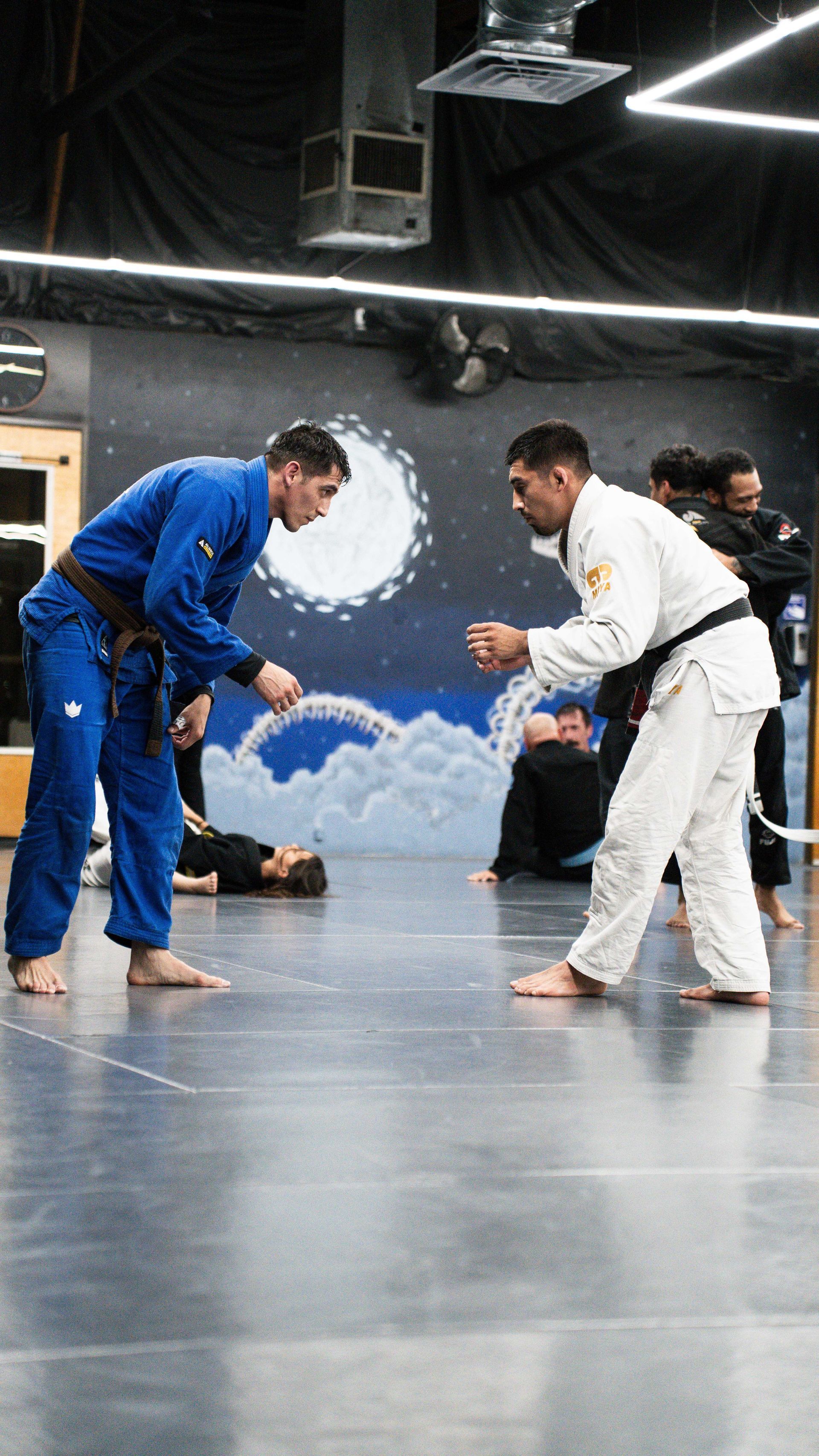
Adults love efficiency. That is why fundamentals matter so much. In Adult Brazilian Jiu Jitsu, fundamentals are not a phase you outgrow. They are the mechanics that make every technique work under pressure.
When we see an adult plateau, it is usually not because the person needs more fancy moves. It is usually because small fundamentals are leaking: posture breaks in closed guard, elbows drift during escapes, head position slips on takedown entries, or a person tries to hold someone down with strength instead of structure. Fix the fundamentals and suddenly everything else feels lighter.
Our approach is to teach you how to win the “invisible” moments:
- How to keep your spine aligned when someone tries to fold you
- How to frame with your forearms and shins so you create space without panic
- How to move your hips first, instead of pushing with tired arms
This matters even more in a crowded city with lots of training options, because the best Adult Brazilian Jiu Jitsu in Las Vegas experience is the one that keeps you improving without grinding your body into dust. Fundamentals protect you while you learn, and that is not a small thing when you have to be functional at work tomorrow.
Secret 3: Recover like an adult athlete, not a college kid
Recovery is not glamorous, but it is the difference between “I trained for three months” and “I train every year.” Adults have jobs, commutes, meetings, parenting, and stress. If you stack hard sparring on top of short sleep and low hydration, you are basically asking your body to tap out before your skills catch up.
We coach adult students to treat recovery as part of the curriculum. That includes sleep, mobility, hydration, and learning to pace rounds. You do not need to win every exchange in training. Sometimes the win is leaving class feeling challenged but not wrecked.
Here is what “adult recovery” looks like in real life:
- Sleep: aim for consistency, because skill learning is tied to sleep quality
- Hydration: dehydration makes cramps and headaches more likely, especially in the Vegas heat
- Mobility: 8 to 12 minutes of hips, ankles, and thoracic spine work goes a long way
- Nutrition: eat enough protein and do not show up to class on fumes
- Pacing: choose rounds where you focus on one goal rather than trying to “out-fight” everyone
If you have old injuries, tell us. If your neck is stiff, tell us. If you are brand new and nervous about sparring, tell us. Adult Brazilian Jiu Jitsu should build you up, not break you down.
Secret 4: Drill with purpose, then use positional sparring to lock it in
A common adult frustration is this: you learn a technique in class, it feels fine in drilling, and then it disappears during live rolling. That is not a character flaw. It is a training structure problem.
We like to think of skill-building in three layers: learn the movement, drill it with the right details, then pressure-test it in a controlled way. Random sparring has a place, but it is not the fastest learning tool by itself. Positional sparring is.
A simple learning loop you can use every week
1. Pick one technique or concept from class (for example, elbow-knee escape, scissor sweep, or knee shield retention)
2. Drill it slowly for clean reps, focusing on the “why” behind each step
3. Add constraints in positional rounds (start in mount, start in half guard, start in closed guard)
4. Finish with a few open rounds where you try to reach that position on purpose
5. Write down one note after class so you do not lose the lesson in the parking lot
When you train like this, your improvement stops being random. You can actually feel your timing change. Your reactions get calmer. And that calm is huge for adults because it reduces injury risk and makes training more enjoyable.
This approach also helps if you are choosing between gi and no-gi, or doing both. Drilling and positional rounds let you adapt grips and control methods without feeling like you are learning two separate sports.
Secret 5: Train with a plan that fits work, family, and energy levels
The biggest secret is not a technique. It is planning. Adult Brazilian Jiu Jitsu in Las Vegas works best when you treat your training like an appointment you respect, but also like a practice you can scale up or down depending on the week.
Some weeks you will feel great and roll hard. Other weeks you will show up tired, drill more, spar lightly, and still count it as a win. That flexibility is how adults stay consistent.
We also see a very real family pattern in Southwest Las Vegas: parents want a place where the household can train under one roof. That is why we keep family logistics in mind when we structure our programs and class schedule. If you are looking for Kids Brazilian Jiu Jitsu in Las Vegas and you want your own adult training time too, it helps when the schedule is designed for real people with real evenings.
What your first week usually looks like
Most new adult students do best when they keep week one simple:
- Day 1: learn the basic positions, how to tap, and how to move safely with a partner
- Day 2: focus on one escape and one control, then do light, guided rounds
- Day 3: repeat key fundamentals and ask one question you have been holding back
You do not need to be in shape to start. Training is what gets you in shape. You just need to show up, listen, and give yourself permission to be new.
Gi vs no-gi: what adult beginners should know
Adults ask this all the time, and it is a fair question. The short version is: both are valuable, and starting with either one can work. Gi training slows things down and gives you more grip-based control, which can help you feel the structure of positions. No-gi often feels faster and more scramble-heavy, and it teaches you strong body positioning and balance without relying on cloth grips.
If your schedule allows, doing both is a smart long-term approach for Adult Brazilian Jiu Jitsu. If your schedule does not allow it, pick the one you can attend most consistently. Consistency is still the multiplier.
What to bring and what to expect in your first class
You do not need much to start, but a little preparation makes the first day smoother:
- Comfortable training clothes that allow movement (we will guide you on gi requirements if needed)
- Water, especially in warm months
- A small towel and sandals or slides for off the mat
- Trimmed nails and no jewelry for safety
- A mindset focused on learning, not “winning”
Expect a friendly, structured environment: warm-up, technique instruction, partner drilling, and optional sparring depending on your comfort level and experience. We will help you choose the right intensity so you leave feeling accomplished, not overwhelmed.
Start Your Adult BJJ Journey With Us
If your goal is to train consistently, learn efficiently, and keep your body feeling good while you improve, we have built our adult program around that exact mission. At
Cobrinha Southwest Las Vegas, we coach Adult Brazilian Jiu Jitsu in Las Vegas with a fundamentals-first approach, smart training structure, and a schedule designed for real adult lives.
Whether you are starting from zero, returning after time off, or balancing training with Kids Brazilian Jiu Jitsu in Las Vegas for your family, we will help you build a plan you can actually follow. When you train with intention, the progress comes faster than you expect and it feels a lot more sustainable.
Put these techniques into practice by
joining a martial arts program at Cobrinha Southwest Las Vegas.